If an AI tool listens to your customer calls, “this call may be recorded” may not be enough consent. In Ambriz v. Google, callers argue that Google’s contact center AI was a third party on their calls, and Google is asking the court to dismiss the case. The answer turns on what your AI vendor is allowed to do with the call data.
The case has been running since 2023, and it’s now at the stage where the question gets answered. Courthouse News reported on 13 October 2026 that Google had asked US District Judge Rita F. Lin, in San Francisco, to throw out the remaining claims. The judge took the motion under submission without ruling. Whatever she decides will be read closely by anyone who runs a contact center with AI in the loop.
What the case is about
The plaintiffs called customer service lines that used Google’s Cloud Contact Center AI. According to the report, those lines belonged to companies including Verizon, The Home Depot, Discover, Uber, Hulu and GoDaddy. While the calls were happening, Google’s software transcribed them and suggested replies to the human agent.
The callers sued under the California Invasion of Privacy Act, usually shortened to CIPA. Section 631 of that law bars anyone other than the parties to a conversation from reading or listening in without everyone’s consent. Section 637.2 lets a person sue for $5,000 per violation, which is why these cases are filed as class actions. Multiply $5,000 by every call to a busy support line and the numbers get serious very fast.
Google’s lawyer put its position plainly at the hearing: “The consent that is required is only consent that a third party may be present and listening in to the call.” In other words, the callers heard a recording notice, so they agreed. The plaintiffs’ reply was that “the caller does not have a choice here because they don’t get to know what they are consenting to.” Nobody told them a separate company was on the line.
The capability test
This isn’t the first round. In February 2025 the same judge refused to dismiss the case, and the reasoning is the part every contact center should understand. CIPA treats a recording tool used by one of the parties, such as a tape recorder, very differently from an outside party listening in. The court said Google’s product could count as an outside party because it had the capability to use call data for its own purposes, such as improving its models. It didn’t matter whether Google actually did that with these calls.
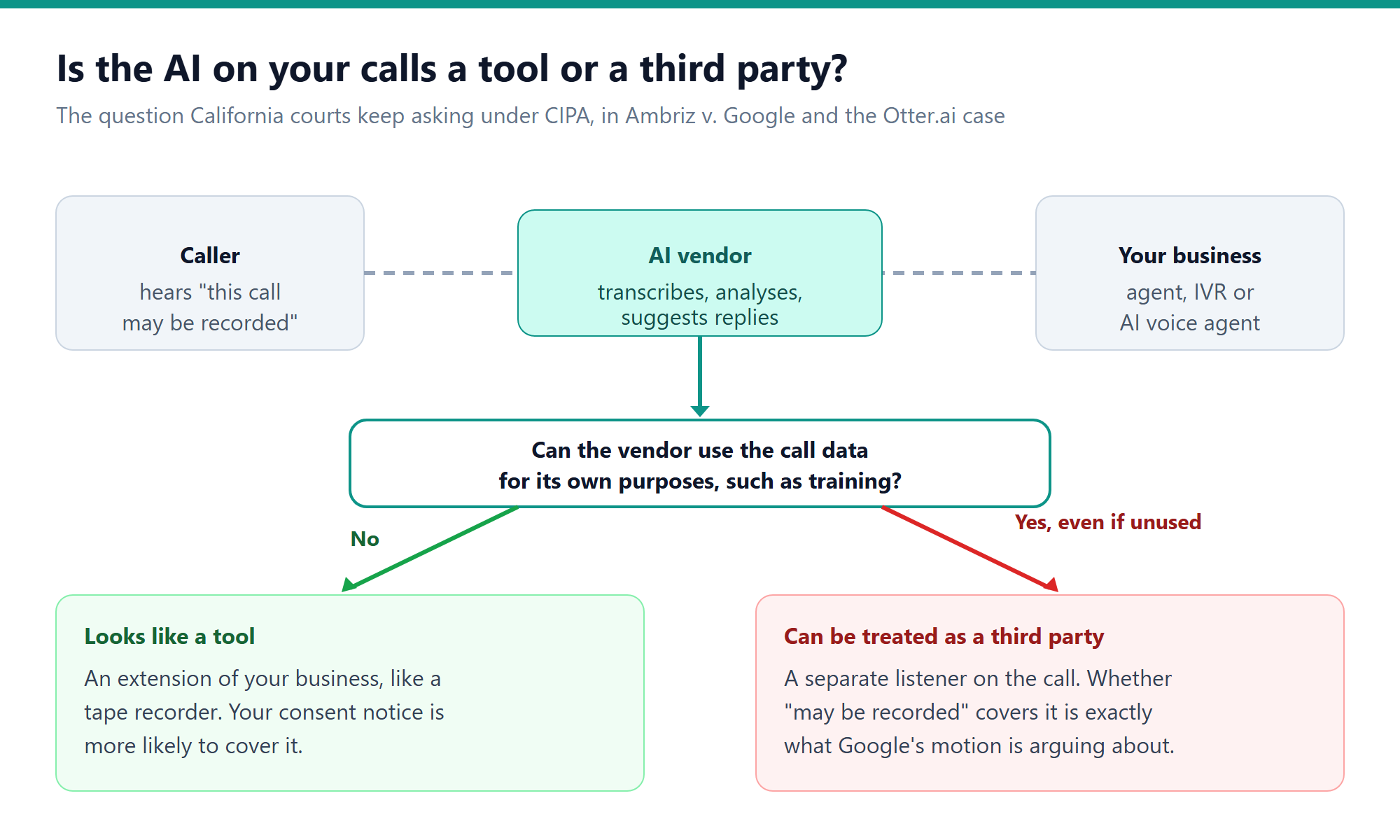
That idea has spread. On 13 August 2026, Judge Eumi K. Lee, in the same court, let the core wiretap and privacy claims against Otter.ai go forward. Otter said it was just a tool used at the direction of the meeting host. The judge rejected that at the pleading stage, because the plaintiffs alleged Otter keeps and uses what it records for its own commercial purposes.
Put the two together and you get a simple test you can apply to your own setup. If your AI vendor can use your call audio or transcripts for anything beyond serving you, a court may treat it as a separate listener. Then the question becomes whether your callers consented to that listener, and a generic recording notice is exactly what’s being argued over.
Why this matters outside California
CIPA is a California law, but the caller’s location is what usually matters, not yours. If people in California call your support line, this applies to you. California is also one of about a dozen states that require consent from everyone on a call before recording, so the same arguments can show up elsewhere.
We’re not lawyers and this isn’t legal advice. But you don’t need a ruling to tighten the parts you control, and none of them are expensive.
Five checks before a cloud AI touches a customer call
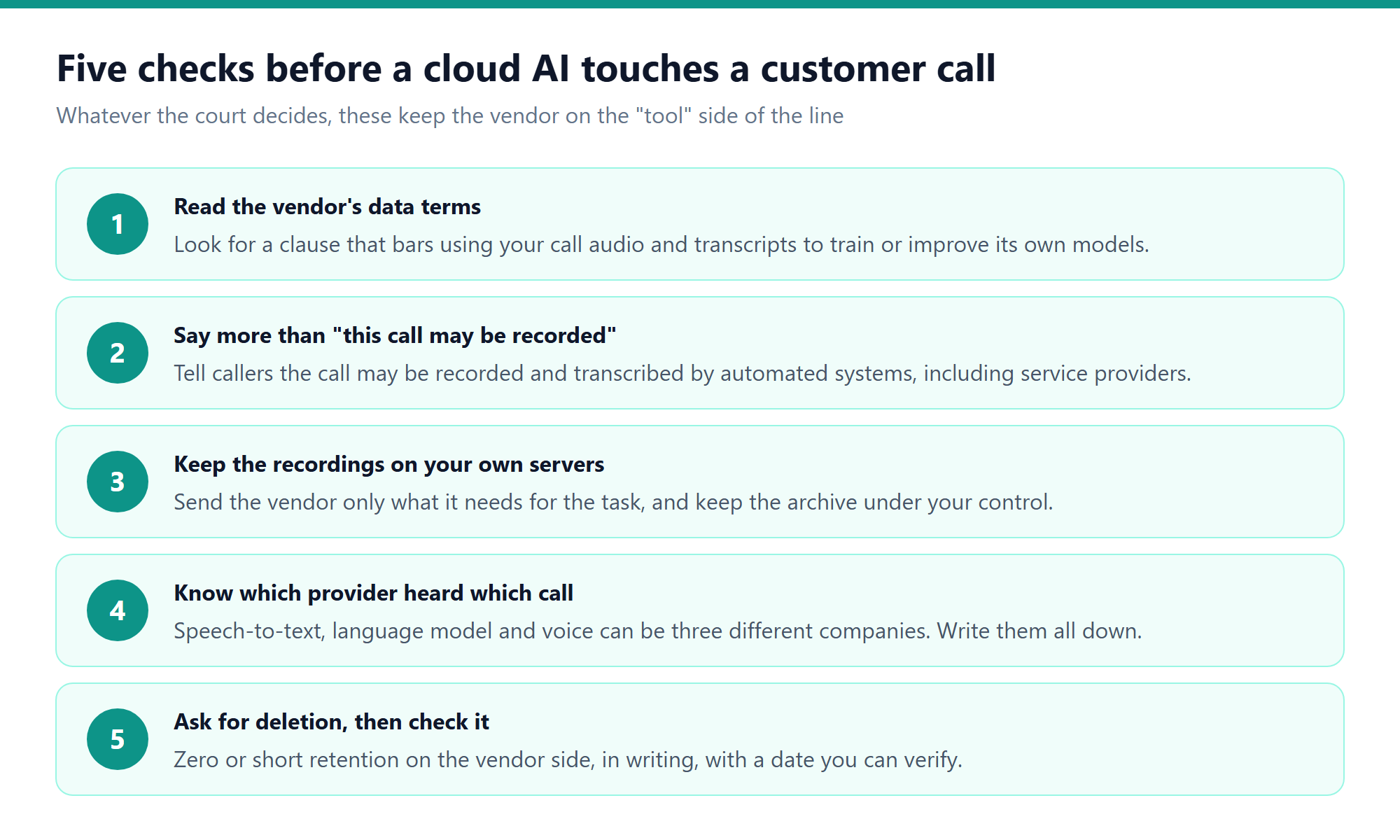
- Read the vendor’s data terms. Look for a clause that stops the provider using your call audio and transcripts to train or improve its own models. If the default allows it, find out how to switch it off and get that in writing. Under the capability test, the permission matters even if it’s never used.
- Say more than “this call may be recorded.” Something like “this call may be recorded and transcribed by automated systems, including our service providers” costs you two seconds and answers the plaintiffs’ main complaint. If an AI voice agent answers the call, it should also say it’s automated. We covered that side in what your contact center must tell callers about AI voice agents.
- Keep the recordings on your own servers. A vendor that only sees a short stream of audio while it does one job has far less to use for its own purposes than one that holds your entire recording archive.
- Know which provider heard which call. A modern voice stack often uses three different companies: one for speech-to-text, one for the language model and one for the voice. Each of them is a potential listener, and each needs its own check.
- Ask for deletion, then check it. Short or zero retention on the vendor side, written into the contract, with a way to confirm it actually happens.
Where ICTContact fits
ICTContact is self-hosted contact center software, so the call recordings sit on your own server. They show up in the Call Recording report, where supervisors can play or download them and filter by agent or campaign. No vendor holds your archive unless you send it there.
The AI Voice Agent, built into the Service Provider Edition, lets you choose the speech-to-text engine, the language model and the text-to-speech voice for each persona. That makes check four easy: you can list exactly which companies hear which persona’s calls. Some parts can stay entirely on your own hardware, such as Piper for the voice. But be clear-eyed about it. If you connect a cloud speech or language provider, that provider’s data terms decide which side of the capability test it falls on, not ours. Self-hosting gives you control over the choice. It doesn’t make the choice for you.
Your greeting and recording announcements are yours to set, so the wording in check two is a change you can make this week. The features page lists the IVR and recording tools involved.
One practical test: pick your three busiest inbound queues and write down every company that touches the audio on those calls. Then find the clause in each contract that says what they may do with it. If you can’t find one, that’s the gap the next lawsuit will look for.
Frequently asked questions
Is “this call may be recorded” enough consent for AI transcription?
That’s exactly what Ambriz v. Google is arguing about. Google says yes. The callers say no, because they weren’t told a separate company was listening. Until the court rules, a more specific notice that mentions automated transcription by service providers is the safer choice.
What is the capability test under CIPA?
It’s the idea that an AI vendor can be treated as a third-party eavesdropper if it has the ability to use call data for its own purposes, such as training its models, whether or not it actually does. The Ambriz court applied it in February 2025.
How much can a CIPA claim cost?
California Penal Code section 637.2 allows $5,000 per violation. Because every recorded call can count, these claims are usually brought as class actions.
Does this apply if my contact center is outside California?
It can. What usually matters is where the caller is. If you take calls from people in California, assume CIPA applies to those calls.
Does self-hosting remove the risk?
It removes one source of it: your recording archive stays with you. Any cloud provider you connect for speech or language processing still needs its own data terms checked, because that provider is the one a court would look at.