
Businesses throughout industries are focusing on customer engagement and operational efficiency in today’s hyper-connected digital environment. Asterisk-Based Contact Center Software plays a transformative role here because communication continues to be the foundation of any thriving business. It enables firms to develop sophisticated, scalable, and completely configurable contact center solutions that are tailored to their unique communication requirements since it is based on the reliable and open-source Asterisk telephony engine. This software offers a single platform for smooth interactions, regardless of whether it’s used to handle incoming customer inquiries, carry out outbound marketing initiatives, or automate call flows.
Unlike proprietary systems that restrict control and flexibility, Asterisk allows for the full integration, modification, and extension of features like IVR menus, call queues, call routing, and CRM connectivity. Due to this versatility, companies are able to increase client happiness while remaining cost-effective. Using Asterisk-Based Contact Center Software, which can handle a variety of communication channels such as voice, SMS, email, and others, ensures real-time collaboration and top-notch service delivery. Consequently, businesses may concentrate on providing worthwhile customer experiences while improving the efficiency, scalability, and dependability of their contact center activities through automation.
What is Asterisk-Based Contact Center Software
Theopen-source Asterisk telephony platform serves as the foundation for Asterisk-Based Contact Center Software, a sophisticated communication management solution. It acts as the foundation for building feature-rich, scalable, and adaptable contact center environments that effectively handle both inbound and outbound communication. The program integrates conventional telephony capabilities with the capability of VoIP (Voice over Internet Protocol) in order to provide a unified and affordable communication experience.
At its foundation, Asterisk provides capabilities for voice processing, call routing, conference bridging, interactive voice response (IVR), and recording, enabling businesses to offer better customer care. It allows for seamless integration with CRMs, ticketing systems, and analytics tools, providing agents with full insight into customer interactions. Depending on their infrastructure and scalability demands, companies may choose to implement the solution either on-site or in the cloud.
Developers can create contact center solutions suited to specific organizational processes by utilizing Asterisk’s open-source nature, which allows for automation, improved reporting, and customized communication. For organizations looking for a balance between performance, customization, and cost, Asterisk-Based Contact Center Software is a great option due to its flexibility. It is an entire communication ecosystem meant to support contemporary customer interaction rather than just a call management system.
How It Works
Integrating VoIP technologies and business communication procedures with the Asterisk telephony engine is how Asterisk-based contact center software functions. The system integrates several communication channels, including SMS, email, web chat, and voice, into a single, cohesive platform. Call routing is where incoming or outgoing calls are handled via SIP trunks or PSTN gateways and routed to the right agent or department according to predetermined rules.
Asterisk handles call control, signaling, and media handling at the backend, facilitating functions such as auto-dialing, call queues, and interactive voice response (IVR). Callers can use the IVR system to navigate automated menus and connect with the appropriate support representative without any human assistance. To guarantee quality assurance and training objectives, calls can also be recorded, monitored, or rerouted.
The program, when integrated with ticketing or CRM systems, gives agents real-time access to caller history and prior engagements, which leads to quicker resolution and improved customer experience. Administrators may monitor agent performance, keep live data, and produce reports to evaluate call traffic and operational effectiveness. In general, Asterisk-based contact center software streamlines communication by automating tasks, decreasing manual work, and making sure that each customer receives prompt, competent help.
Key Features of Asterisk-Based Contact Center Software
Interactive voice response system
Callers are greeted by the integrated IVR system, which also guides them through voice menus to automate customer interactions. By directing clients to the appropriate agent or department, it minimizes human involvement. This boosts professionalism and saves time. The IVR may be set up with ease to provide multilingual support and multi-level choices. When dealing with high call volumes, it helps to provide consistent experiences. Additionally, integration with CRMs and databases enables more tailored responses for greater customer satisfaction.

Automated Call Distribution (ACD)
Inbound calls are intelligently routed by ACD to the best available agent based on skill, availability, or priority. This guarantees a more equitable distribution of work among agents and speedier resolutions. It increases the effectiveness of the service, lowers call abandonment, and shortens wait times. Companies may create routing strategies to align with client profiles or marketing initiatives. Because of Asterisk’s versatility, ACD regulations may be easily changed and improved to meet evolving business requirements. It boosts customer confidence by providing quick responses.
Auto Dialer and Predictive Dialer
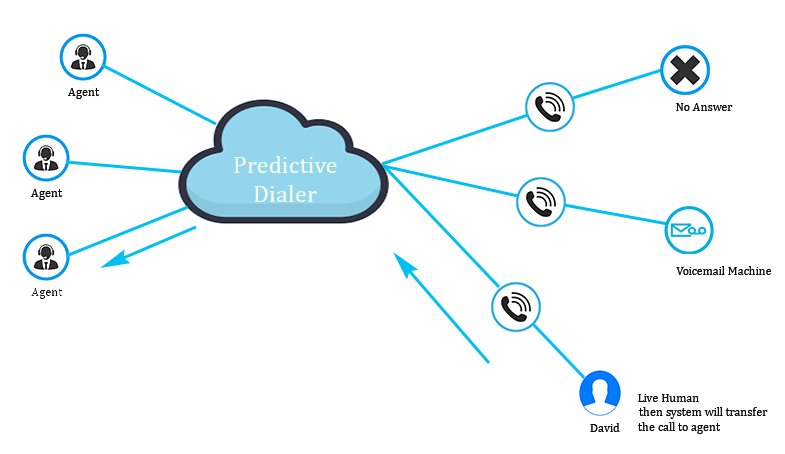
An asterisk-based contact center program comes with a predictive dialer that automatically dials outgoing calls for campaigns like sales, collections, and surveys. It only connects live calls to agents; it identifies unanswered calls, busy signals, and voicemail. With this tool, managers may easily schedule campaigns and keep an eye on performance indicators, which improves agent productivity and talk time. Additionally, the dialer offers selectable manual, progressive, or preview dialing methods for versatility. With little effort, it’s a tried-and-true tool for reaching a large audience.
Call Recording and Monitoring
The system enables administrators to keep, save, and analyze calls safely. Supervisors are able to supervise live conversations and provide real-time advice to agents. Call recordings are helpful for training, compliance, and conflict resolution. To enhance communication, quality assurance teams can examine tone, speed, and content. For simple access, data can be saved in the cloud or locally. This feature fosters transparency, accountability, and ongoing contact center operational advancements.
Real-time reporting and analysis
Managers can monitor call volumes, agent activity, and performance metrics using comprehensive reporting tools. Live data is shown on real-time dashboards, facilitating rapid decision-making. Trends, bottlenecks, and productivity gaps are identified with the aid of analytics. Long-term planning and forecasting are supported by historical data. By using visual charts and comprehensive logs, management can make a fair evaluation of the degree of client happiness. This feature promotes well-informed decision-making and operational excellence in every campaign.
CRM Integration
Because of its flawless integration with CRM systems, agents may now access all client information at any time during a call. It facilitates quick problem resolution and more customized communication. The CRM database is updated in real time with all call logs, recordings, and notes. By lowering the amount of manual data entry, integration enhances the effectiveness of the workflow. It also improves the monitoring of leads, cases, and client journeys. It is simple to integrate with systems like ICTCRM, Salesforce, and HubSpot thanks to Asterisk’s open APIs.
Communication via multiple channels
Companies can manage voice, SMS, email, and online chat from a single platform with the help of the program. Consumers can contact us using their preferred mode of communication, which offers flexibility and convenience. This integrated strategy increases interaction rates and shortens response times. Agents are able to move between channels without losing the context of the conversation. It enables businesses to maintain a uniform brand identity across all communication channels. Ultimately, it improves client happiness and experience.
Skill-Based Routing
Call distribution to agents with specialized knowledge is supported by Asterisk-based contact center software. This guarantees that queries pertaining to technical or specialized topics are handled effectively. The function helps raise customer happiness and first-call resolution rates. Furthermore, it balances workloads by routing calls based on the skill and availability of the agent. Managers have the flexibility to adjust the routing logic to fit campaigns. Skill-based routing immediately promotes professional and individualized customer interactions.
Priority Handling and Call Queueing
The queuing system handles waiting calls well during periods of high call traffic. Customers hear music, commercials, or wait time projections while waiting in line. VIP customers and emergency calls are given priority treatment, ensuring that they are answered first. The queue system enhances the caller experience and minimizes call drops. Administrators can reallocate resources and keep an eye on queue lengths in real-time. No chance or customer request will be overlooked because of this feature.
Flexibility and Adaptability
Contact center software based on Asterisk is easily scalable to accommodate the requirements of expanding enterprises. It can be used in a variety of environments, from a simple helpdesk to a high-end contact center. Without incurring significant expenditures, businesses may add users, campaigns, or extensions. Because of its open-source architecture, it may be customized extensively, from dial-up rules to interface design. Its capabilities can be expanded by developers using plugins or APIs. Due to its adaptability, it is a future-proof communication system created to meet the changing needs of the commercial world.
Challenges of Asterisk-Based Contact Center Software
Intricate Installation and Setup: Technical proficiency is necessary to install and set up Asterisk-based contact center software. VoIP setup, module integration, and installation may be difficult for companies that lack experienced administrators. It may be difficult for those without technical expertise to manage firewalls, routing policies, and SIP trunks.
Upgrades and Maintenance: System updates, maintenance, and patches must often be installed manually because Asterisk is an open-source product. Maintaining the platform’s security and compatibility with emerging technology requires ongoing monitoring. Businesses may have downtime or performance difficulties without adequate IT assistance.
Restricted scalability without optimization: Poor configuration or insufficient hardware resources can limit performance despite scalability. The optimization of dial plans, codecs, and server capacity may be necessary for large-scale installations. If there is no such tweaking, system responsiveness and call handling may suffer.
Dangers to data privacy and security: Data breaches, toll fraud, and SIP attacks are just a few of the security risks that VoIP systems face. Customer information may be at risk without robust firewalls, encryption, and authentication protocols. Consistent audits and continuous security monitoring are essential for protection.
Integration Issues with Third-Party Programs: Integrating Asterisk with CRMs, ticketing systems, or analytics tools may require API configuration and coding expertise. Various systems may have compatibility problems. The complexity of integration might cause delays in deployment and necessitate more development resources.
Overcome Challenges of Asterisk-Based Contact Center Software
Easy setup with professional help: Companies may rely on managed hosting solutions or expert Asterisk service providers to help them get over complicated configuration problems. These professionals are skilled at managing setup, SIP settings, and integration jobs. For beginners, deployment is also made simpler by using GUI-based management tools or pre-built Asterisk distributions.
Regular upkeep and automatic updates: System backup automation and regular update scheduling guarantee consistent operation. Businesses should have technical personnel in place to update modules, implement security fixes, and track logs. Using paid maintenance services or community support can also help keep the program functioning at its best and reduce downtime.
Resource Optimization and Scalable Architecture: Adopting a distributed architecture enhances reliability in big contact centers. Load balancing, virtualization, and clustering are ways that businesses can efficiently handle larger call volumes. By optimizing codecs, bandwidth, and dial plans, scalability is improved, and uninterrupted communication is guaranteed even during the busiest times.
More Stringent Security Procedures: The contact center is shielded from VoIP attacks by the implementation of robust security procedures like TLS, SRTP, and firewall regulations. Data encryption and routine vulnerability assessments prevent unwanted access. Additional measures that guarantee regulatory compliance and customer data protection include establishing role-based rights and secure authentication.
Smooth integration between CRM and API: The use of middleware and standardized APIs makes integration with third-party systems easier. Companies can combine analytics tools, ticketing systems, and CRMs with little programming. By selecting open-source connectors or Asterisk-compatible solutions, complexity is reduced, facilitating seamless data exchange and automation across applications.
Advantages and Disadvantages of Asterisk-Based Contact Center Software
Advantages:
Affordable remedy: Asterisk’s open-source nature results in lower license costs than proprietary systems. Companies are able to install feature-rich contact centers without making significant initial expenditures. It’s perfect for companies and startups looking for affordable scalability.
Very Adaptable: Companies can customize call flows, IVR menus, dashboards, and functions to suit their particular business requirements. The versatility of open source makes it possible to connect with third-party apps, analytics, and CRM systems. The system is perfectly aligned with workflows due to its customizability.
Flexible and Scalable: From little help desks to big corporate contact centers, Asterisk may expand alongside the company. Its modular design makes it simple to introduce new users, campaigns, and capabilities. Companies may adjust to shifting communication needs without having to replace the entire system.
Multi-channel communication: Provides a single interface for voice, SMS, email, and chat. By allowing consumers to select their favorite channel, satisfaction and engagement are increased. All interactions are handled effectively by agents without having to switch between various platforms.
Modern Features: Contains real-time data analysis, monitoring, call recording, ACD, auto-dialer, and IVR. These characteristics improve operational efficiency and agent performance. Automation, better reporting, and improved workflows all help enterprises.
Disadvantages:
Intricacy in Technique: Demands qualified staff for installation, setup, and upkeep. Managing VoIP infrastructure and call routing can be difficult for non-technical teams. Professional help may be necessary during the initial deployment.
Upkeep duties: Constant monitoring, security fixes, and updates are necessary for open-source systems. The system is susceptible to downtime or security flaws if it is not properly maintained. Businesses must allocate IT resources for maintenance.
Dangers to Security: If not adequately protected, VoIP networks are susceptible to data breaches, toll fraud, and SIP attacks. To safeguard sensitive data, companies must put monitoring, firewalls, and encryption in place. Maintaining security necessitates constant vigilance and adherence to best practices.
Integration Issues: API and coding expertise might be necessary to integrate with analytics, CRM, or other programs. Some third-party programs may have compatibility problems. Adding integration may increase development time and expense.
Reliance on Resources and Hardware: Effective large-scale deployments need optimized hardware, adequate bandwidth, and powerful servers. Inadequate resources might cause dropped calls or performance problems. Effective planning and infrastructure investments are essential for seamless operations.
Frequently Asked Questions:
What Does Asterisk-Based Contact Center Software Do?
Designed to handle incoming and outgoing calls efficiently, it is an open-source communications platform based on the Asterisk telephony engine. It integrates features like call routing, IVR, auto-dialing, and CRM connection to improve customer interactions.
Which businesses may gain from it?
Organizations of all sizes, from tiny startups to major corporations, that need customer support or outbound communication can gain from it. Businesses in sectors such as telecom, banking, e-commerce, and healthcare frequently utilize Asterisk to provide cost-effective and scalable contact center solutions.
What reasons should a business use Asterisk-based software?
Compared to exclusive systems, it has flexibility, scalability, and cost savings. With open-source customization, multi-channel support, and sophisticated features, it’s perfect for firms that want total command over their communication infrastructure.
How does it function?
The program integrates with CRMs or ticketing systems, handles call routing using IVR and ACD, and establishes calls through SIP trunks or PSTN. It offers analytics for improved decision-making, tracks performance, documents interactions, and automates operations.
When is the ideal time to implement this program?
It’s perfect for a business that wants to increase the efficiency of its customer care, expand its operations, or automate its call management. The greatest beneficiaries are organizations seeking to cut costs, increase agent efficiency, and regulate multi-channel communication.
Contact Center Terms You Should Know
Asterisk-based contact center software bundles a lot of moving parts. These are the terms that describe how a call actually finds the right agent.- Asterisk
- The open-source telephony engine ICTContact is built on. It handles the calls, the IVR, and the dialing under the hood.
- IVR (Interactive Voice Response)
- The menu callers hear (press 1 for sales, and so on) that gathers intent before a call is routed.
- ACD (Automatic Call Distribution)
- The logic that sends each inbound call to the right queue or agent based on your rules.
- Skill-based routing
- Routing a caller to the agent best equipped to help, by language, product, or priority.
- Predictive dialer
- An outbound mode that dials several lines per agent and connects only the live answers, to cut idle time.
- WebRTC agent panel
- The browser-based console where agents take and place calls, with no desk phone or plugin.
- Blended campaign
- Letting agents handle inbound and outbound in one flow, so they stay busy as call volume shifts.
- Multi-tenant
- One install that runs separate, isolated contact centers for many customers, which is how white-label providers operate.