Security firm Varonis has gone public with Rogue Agent, a flaw in Google’s Dialogflow CX that let a single malicious code snippet hijack every AI agent in a cloud project. The bug is fixed now, but the disclosure raises a hard question for anyone running conversational AI: do you actually know where your bot’s code runs?
The write-up landed on July 17 via The Hacker News, and it deserves your attention even if you’ve never touched Dialogflow. The failure pattern behind it applies to almost every managed AI runtime on the market.
What Actually Happened
Dialogflow CX lets builders drop custom Python into conversational flows through a feature called Code Blocks. Handy. You can look up an order, calculate a refund, or format a reply without leaving the platform.
Here’s the part most customers never saw. All of those Code Blocks, across every agent in a Google Cloud project, executed inside one shared, Google-managed Cloud Run instance. Not one sandbox per agent. One runtime for everything.
Varonis researchers found that the wrapper file coordinating those executions, code_execution_env.py, sat in a writable location. So a Code Block could simply overwrite it. Once overwritten, the poisoned wrapper ran for every later execution, from every agent in the project, until the instance recycled.
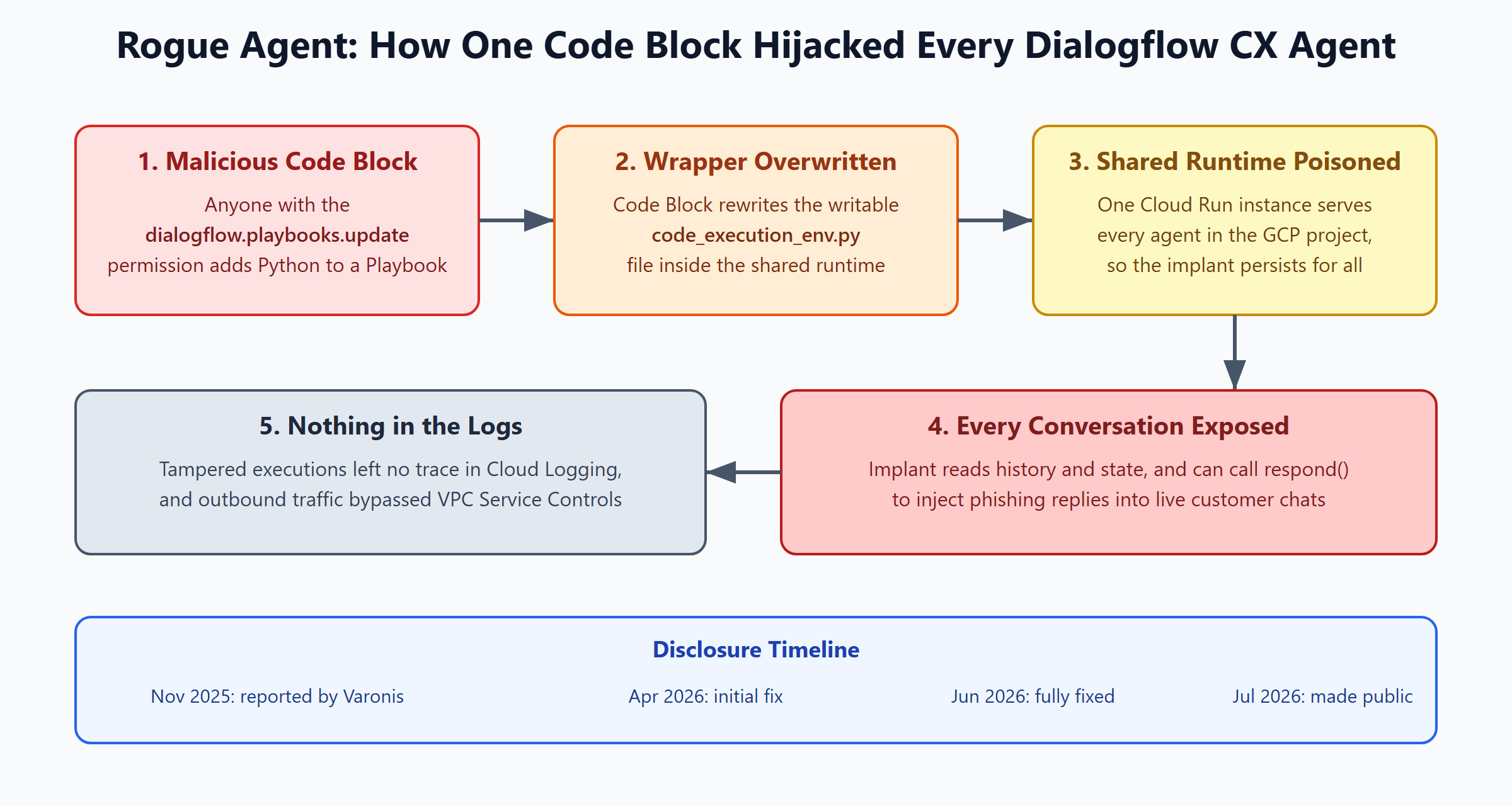
The implant had access to the conversation history object, session state, and the respond() function. Read that list again. It means an attacker could silently read every customer conversation flowing through every agent, and worse, put words in your bot’s mouth. Varonis demonstrated bot-driven phishing: the compromised agent asks the customer to “verify” card details mid-chat, and the data goes straight out to an attacker server.
Why This One Stings More Than a Typical CVE
Three details make Rogue Agent nastier than the average cloud bug.
It was invisible. Tampered executions left no trace in Cloud Logging. Your SOC could stare at the dashboards all day and see a perfectly healthy bot.
It ignored your network controls. The shared runtime had unrestricted outbound internet access, which bypassed VPC Service Controls. The exact tool teams deploy to stop data exfiltration didn’t apply to the box doing the exfiltration.
The entry bar was low. The attacker needed the dialogflow.playbooks.update permission. That’s not an admin role. It’s a permission plenty of developers, contractors, and integration partners hold as a matter of course. One compromised laptop or one disgruntled insider was enough.
The timeline is worth noting too. Varonis reported the flaw in November 2025. Google shipped an initial fix in April 2026 and closed it fully in June 2026. That’s roughly eight months from report to full fix, and customers learned about it this week. No CVE was assigned. If your compliance posture depends on tracking CVEs, this one would have sailed right past you.
The Real Lesson: Shared Runtimes Concentrate Risk
Google fixed the file permissions, so why keep talking about it? Because the architecture that made the bug possible is still standard practice across the AI platform market.
When a vendor runs your agent’s custom code in a multi-agent, vendor-managed container, you inherit three blind spots at once. You can’t inspect the runtime image. You can’t set its egress rules. And you can’t watch its file system. You’re trusting that the vendor got the isolation right, and Rogue Agent shows that even Google, with effectively unlimited security budget, got it wrong for a while.
In my view, the uncomfortable truth is that “serverless AI” quietly reintroduced the shared-hosting security model that the industry spent a decade escaping. One tenant’s code, one writable file, everyone’s data.
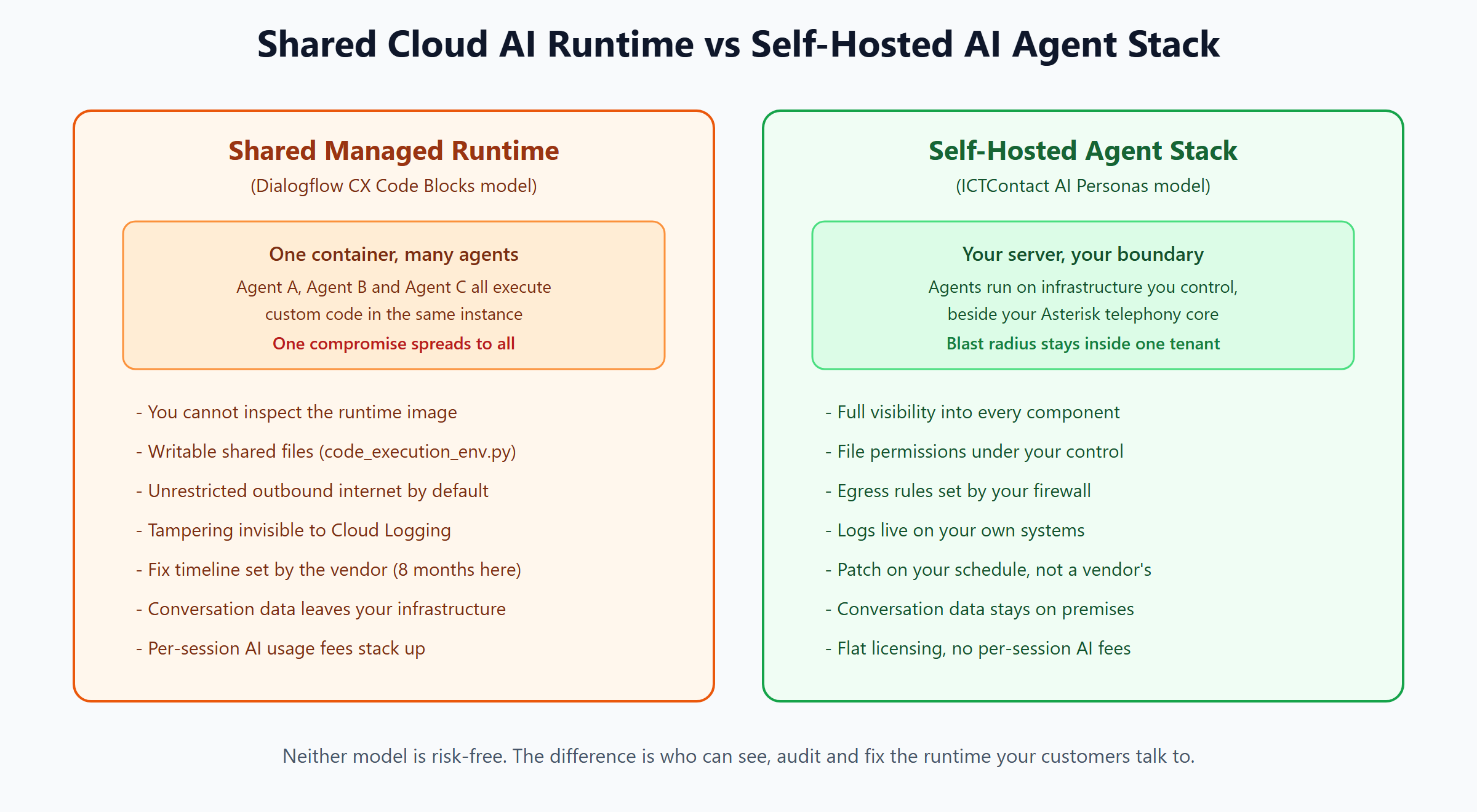
Self-hosting flips those blind spots. When your AI agents run on infrastructure you control, the blast radius of any compromise stays inside your own boundary. You set the file permissions. Your firewall writes the egress rules. Your logs live on your systems, where tampering is at least detectable. And you patch on your schedule instead of waiting eight months for a vendor to finish theirs.
That’s the model we build on. ICTContact’s AI Personas run on your own server, beside the Asterisk telephony core, so customer conversations never leave your infrastructure. Each deployment serves one tenant. There’s no shared wrapper file waiting to be overwritten by a stranger’s code block, because there’s no stranger in the box.
If You Run Dialogflow CX Today, Do These Four Things
Varonis published concrete audit steps, and they’re sensible. Even though the flaw is patched, you want to know whether anyone probed it while it was open.
- Audit who holds
dialogflow.playbooks.update. Treat that permission like production deploy access, because that’s what it is. Strip it from anyone who doesn’t actively edit playbooks. - Turn on DATA_WRITE audit logs for Dialogflow, if they aren’t already. Look back through playbook edit history for changes nobody remembers making.
- Check failed-request logs around your agents for odd spikes, which can indicate someone experimenting with Code Block payloads.
- Read every Code Block in the project. Line by line. Anything touching file paths, network calls, or environment variables deserves an explanation from whoever wrote it.
And one step Varonis didn’t list: ask your vendor, in writing, whether your agents share an execution environment with other agents or other customers. The answer will tell you a lot.
Questions to Ask Any Conversational AI Platform
Whether you’re evaluating contact center software or a standalone bot platform, the Rogue Agent disclosure hands you a ready-made vendor questionnaire.
Where does custom code execute, and is that environment shared? Can I see execution logs, and could the runtime tamper with them? What outbound network access does the runtime have? How fast do runtime security fixes ship, and will I be told? Would a compromise of one agent affect others?
A vendor with good isolation answers these in a paragraph. A vendor who hedges is telling you something too.
Fresh incidents keep making the same point from different angles. We covered the operational side of this in our piece on running AI voice agents inside the contact center: AI that touches customer data is production infrastructure, and it deserves production-grade scrutiny. Rogue Agent just demonstrated what happens when it doesn’t get it.
FAQ
What is the Rogue Agent vulnerability?
Rogue Agent is a flaw in Google Dialogflow CX, found by Varonis, that let a malicious Code Block overwrite a shared wrapper file (code_execution_env.py) in the runtime serving all agents in a GCP project. The implant could read every conversation and inject fake bot replies, with no trace in Cloud Logging.
Is Rogue Agent fixed?
Yes. Google shipped an initial fix in April 2026 and completed remediation in June 2026, before the July 2026 public disclosure. No CVE was assigned, so it won’t appear in CVE-based vulnerability feeds.
Was any customer data actually stolen?
There’s no public evidence of exploitation in the wild. But because tampered executions left no logs, absence of evidence is weak comfort. That’s why the recommended audits focus on permission holders and playbook edit history rather than runtime logs.
Who could have exploited this flaw?
Anyone holding the dialogflow.playbooks.update IAM permission in your project: a malicious insider, a compromised developer account, or a third-party integrator. It didn’t require admin rights or a break-in to Google’s own systems.
How do self-hosted AI agents avoid this class of problem?
Self-hosted agents, like ICTContact’s AI Personas, execute on infrastructure you control, one tenant per deployment. There’s no multi-agent shared runtime, so a compromise can’t spread between agents or customers, and your own firewall and logging apply to the AI just like any other production service.
Does this mean cloud AI platforms are unsafe?
Not unsafe, but not automatically safe either. Managed platforms trade visibility for convenience. If you stay on one, demand answers about runtime isolation, egress control, and disclosure timelines. If those answers matter enough to your compliance posture, self-hosting is the cleaner path.