Building an AI voice agent no longer needs a developer. You describe the job in ordinary sentences, point the system at your existing procedures, and it starts answering calls. That part became easy this year. What didn’t become easy is everything after it: guardrails, escalation rules, CRM writeback, and knowing the moment the agent should stop talking and get a person on the line.
If you’ve been shopping for contact center software in the last six months, you’ve seen the demo. Someone types a paragraph. A voice agent appears. The room claps. Then the pilot goes live and containment sits at 31 percent, and nobody can explain why.
The build step commoditised itself in about eight weeks
Talkdesk showed its Agent Builder at CCW in Las Vegas in June, pitching a zero-prompt setup where you upload standard operating procedures and the platform works out the flow. xAI opened a beta of a voice agent builder for Grok on 1 July. DevRev shipped voice AI on 23 July. Three very different companies, one identical promise: you won’t write a single line of dialogue logic.
They’re all telling the truth. That’s what makes this interesting rather than annoying. Natural-language agent construction genuinely works now, and it works well enough that treating it as a differentiator is a bit like advertising that your phone system supports hold music.
So the honest question for anyone evaluating platforms in the second half of 2026 isn’t whether the vendor has a plain-English builder. Assume they do, or will by Christmas. The question is what the platform does on the calls the agent shouldn’t finish.
Eight steps, and only two of them are the fun part
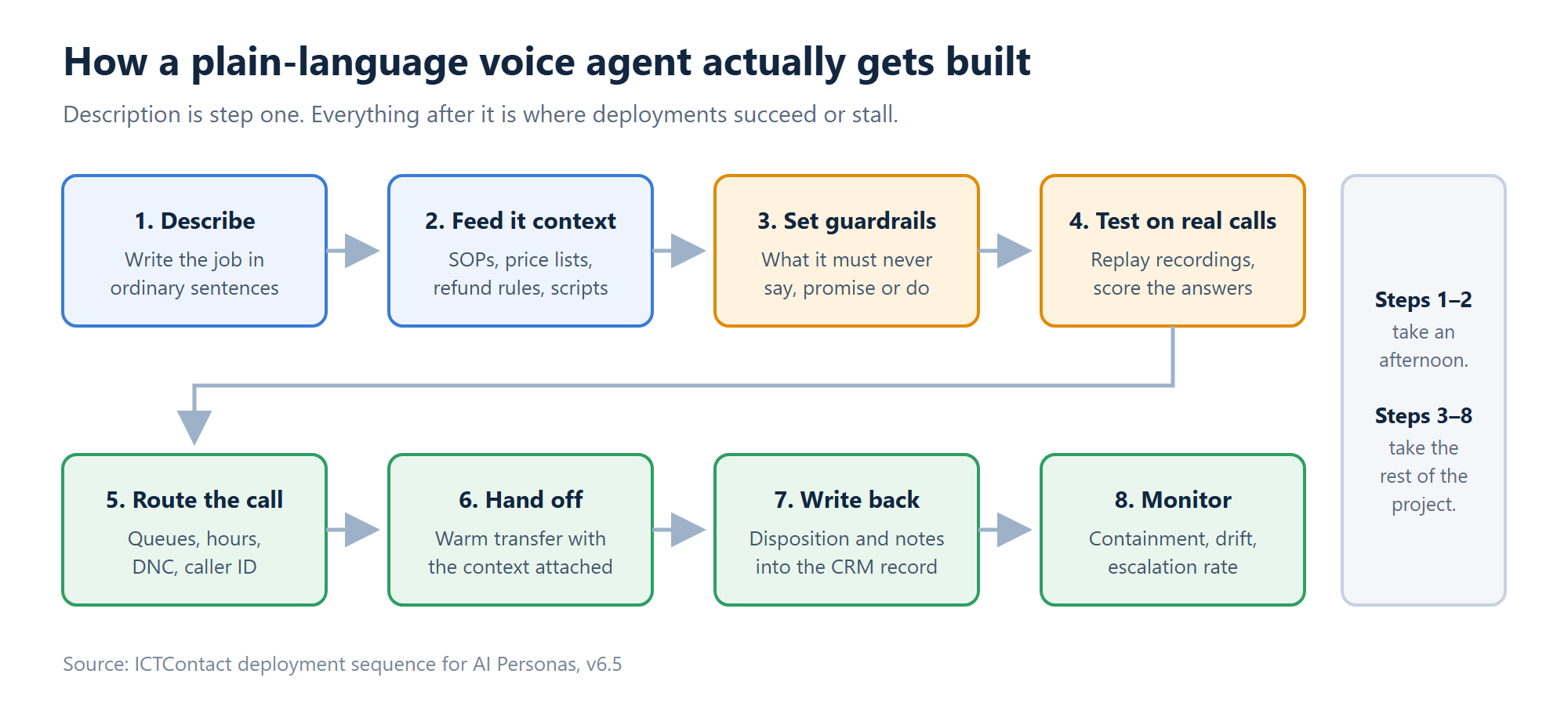
Here’s the shape of a real deployment. Steps one and two are the demo. Steps three through eight are the project.
- Guardrails. What the agent must never say, never promise, and never authorise. A refund ceiling. A hard block on medical or legal advice. A rule that it never confirms an account balance without verifying identity first.
- Testing against real audio. Not scripted test cases. Actual recordings from your queue, replayed, scored by someone who knows what a good answer sounds like in your business.
- Routing. Business hours, time zones, do-not-call lists, caller ID selection, overflow queues. All the boring telephony that decides whether the call reaches the agent at all.
- Handoff. Covered below, because it deserves its own section.
- Writeback. Disposition, transcript summary and next action landing on the right record in the right system.
- Monitoring. Containment rate, escalation rate, and drift. Agents that behaved in week one develop habits by week six.
My blunt view: any vendor who spends the whole demo on step one is showing you the easy half and hoping you don’t ask about the rest.
The handoff is the product
Callers forgive a bot that says “I’ll get someone who can help with that.” They do not forgive being asked to repeat their account number to the human who picks up. The second one reads as incompetence, and it’s entirely a software problem.
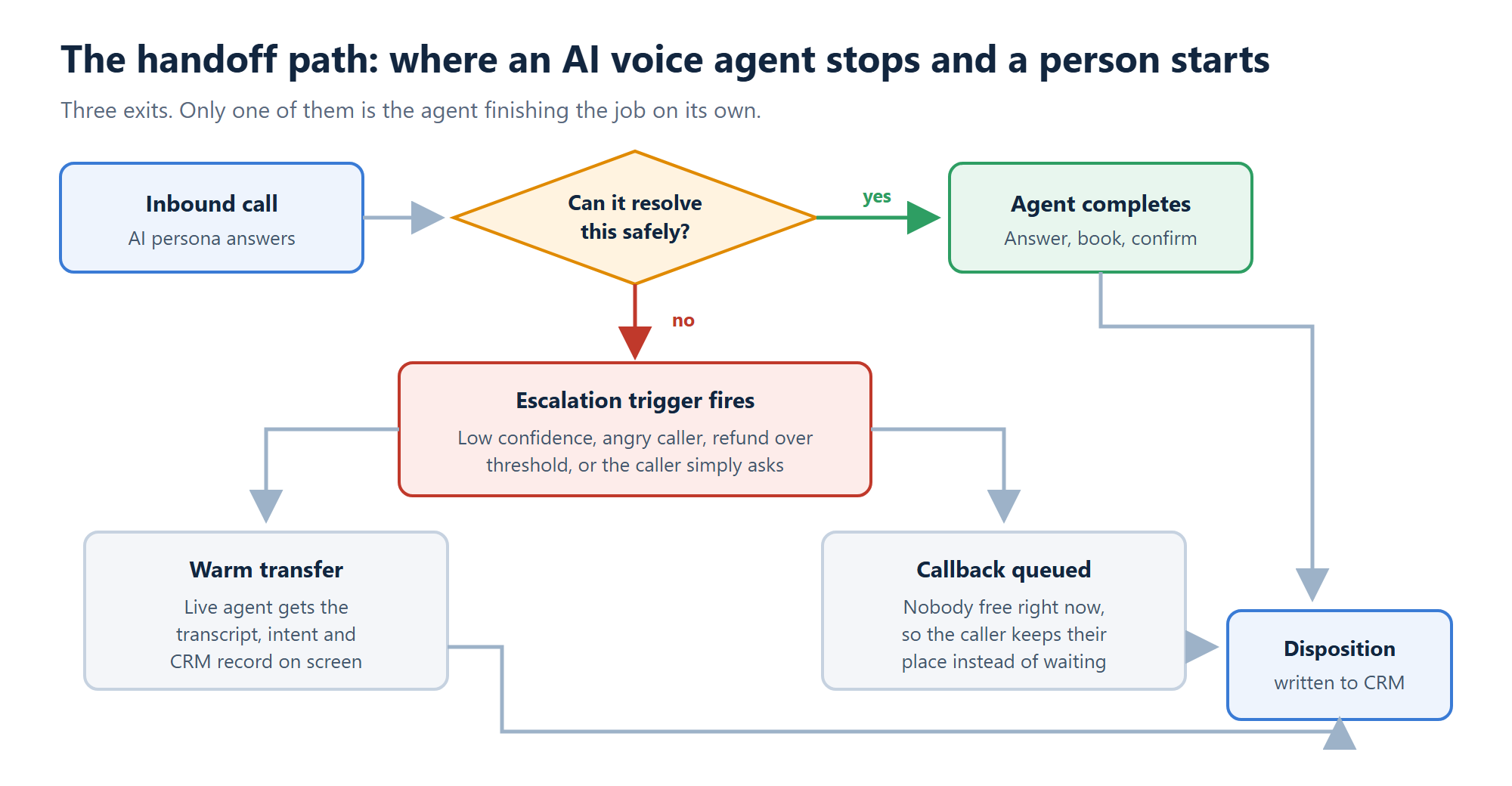
Three exits, and only one of them is the agent finishing the job alone. A warm transfer means the live agent’s screen already shows the transcript, the detected intent and the customer record before they say hello. A queued callback means the caller keeps their place instead of listening to a loop. Both paths end the same way: something gets written to the CRM, so the next person who touches this customer knows what happened.
Test this yourself during any evaluation. Call the demo line, deliberately push the agent past its limit, and watch what the human receives. If the answer is “a ringing phone and no context”, the plain-English builder in front of it doesn’t matter much.
Governance arrived at the same time, and that’s not a coincidence
Alongside the builder announcements, vendors started shipping operations consoles for supervising fleets of agents. Talkdesk called theirs a CXA Operations Center. The naming varies. The reason doesn’t.
Once anyone in operations can create an agent in an afternoon, you get agent sprawl. Twelve agents, four of them abandoned, two of them quoting a pricing table that changed in March. Somebody has to own version control, approval, and the ability to switch one off quickly.
Ask a vendor three questions here:
- Who can publish an agent to a live queue, and does that require a second approval?
- Can you roll back to a previous version of an agent’s instructions after a bad change?
- Is there one screen showing every live agent, its owner, and when it last got touched?
If those three answers are vague, the governance story is a slide, not a feature.
Where ICTContact fits
ICTContact v6.5 ships AI Personas, built on Asterisk. You define a persona in ordinary language, give it the context it needs, and it handles inbound and outbound conversations across voice, SMS, fax and email from the same platform.
The design decision worth calling out is that personas sit inside the existing campaign and queue engine rather than beside it. An AI persona respects the same DNC filtering, the same time-zone restrictions and the same caller ID rules as any other campaign, because it’s running through the same dialer. Escalation targets an existing queue, so the warm transfer lands on the agent panel your team already uses.
Writeback runs through the platform’s CRM integrations, which means a persona’s disposition appears on the contact record the same way a human agent’s would. There’s no separate AI log to reconcile at month end, which is a small thing until you’ve had to do the reconciling.
The full capability list lives on the features page if you want the detail.
A short evaluation checklist
Print this, or don’t. Either way, these are the questions that separate a demo from a deployment:
- Can I replay 50 of my own call recordings through the agent before go-live, and see a score for each?
- When the agent escalates, what exactly appears on the human’s screen?
- Does the agent obey my DNC list and my calling-hours rules, or are those enforced somewhere else?
- Where does the disposition get written, and can I see it in my CRM without an export?
- What’s the containment rate on a comparable deployment, and how was it measured?
- Who can push a change live, and how fast can I undo it?
The vendors who answer these quickly and specifically tend to be the ones who’ve run deployments past the pilot stage. The ones who redirect back to the builder demo usually haven’t.
One number worth watching more than containment
Containment gets quoted because it’s flattering. Escalation quality doesn’t have a tidy metric, so it goes unmeasured, and that’s backwards.
Try this instead: for every call the agent escalated last week, measure how long the human spent before they understood the problem. Thirty seconds of re-explaining is a failed handoff even if the call ended happily. Sample twenty of them and listen. It takes an hour and tells you more about the deployment than a month of dashboard averages, because the dashboard counts transfers while the recordings show you what the customer actually experienced.
What this means for the rest of 2026
Expect the plain-English builder to disappear from comparison tables by early next year, the way “cloud-based” quietly stopped being a selling point. What replaces it is harder to screenshot: escalation quality, governance, and whether the agent’s work shows up in the systems your business already runs on.
That’s a better place for the competition to sit. Anyone can generate a convincing thirty-second voice demo. Far fewer can show you a month of call data where the handoffs were clean and the CRM was accurate afterwards.
Frequently asked questions
Do I still need a developer to build an AI voice agent?
Not to build one. You’ll still want technical help for the integration work: connecting the CRM, mapping dispositions, configuring SIP trunks and setting escalation targets. The writing part is now genuinely a business-user task.
What containment rate should I expect?
It depends entirely on call mix. Simple, high-volume intents like order status or appointment confirmation can run high. Mixed support queues with billing disputes land much lower. Treat any single headline number quoted without the call mix behind it as marketing.
How is an AI persona different from an IVR?
An IVR presents fixed options and waits for a selection. A persona takes an open-ended sentence, works out what the caller wants, and can ask a clarifying question. The practical difference is that callers stop pressing zero immediately.
Can an AI agent make outbound calls as well as answer them?
Yes, in ICTContact the same persona can run on an outbound campaign. The compliance rules matter more here: calling hours, consent records and DNC filtering apply exactly as they do to human-dialed campaigns, and in most jurisdictions disclosure requirements apply too.
What happens if the agent gets something wrong on a live call?
That’s what guardrails and escalation thresholds are for. Set a confidence floor, define the topics it must never handle alone, and cap what it can authorise. Then monitor the escalation rate, because a sudden drop usually means the agent has started answering things it shouldn’t.
Is it worth waiting for the technology to settle?
Waiting for the builders to improve is probably pointless, since that part is already good. Waiting until you’ve cleaned up your call dispositions and written down your escalation rules is time well spent, because the agent will inherit whatever mess is already there.