Short answer: in a growing number of states, yes. If an AI voice agent could pass for a person, several states want a clear notice, and a few want it before the caller says anything. There’s no federal standard. The practical fix is one honest sentence at the top of every call.
That sentence is cheaper than the alternative. Building a state-by-state matrix into your dialer sounds precise until a caller ports a number, travels, or forwards their line, and your carefully scoped rule fires in the wrong place. Most teams we talk to land on the same conclusion after an afternoon with the statutes: disclose everywhere, stop thinking about it.
Here’s what the rules actually say, and where contact centers keep tripping.
There’s no federal AI disclosure rule, and that’s the problem
You might expect a single national answer to “do I have to tell people it’s a bot?” There isn’t one. What exists instead is a patchwork of state laws written at different times, for different worries, with different triggers. Some target deceptive commerce. Some target companion apps aimed at lonely teenagers. A few now reach ordinary customer service.
The result is that two identical calls can carry different obligations depending on where the handset happens to be. For anyone running outbound campaigns across state lines, that’s not a theoretical problem.
The states that already ask for proactive notice
Three are worth knowing by name, because they reach normal commercial conversations rather than niche use cases.
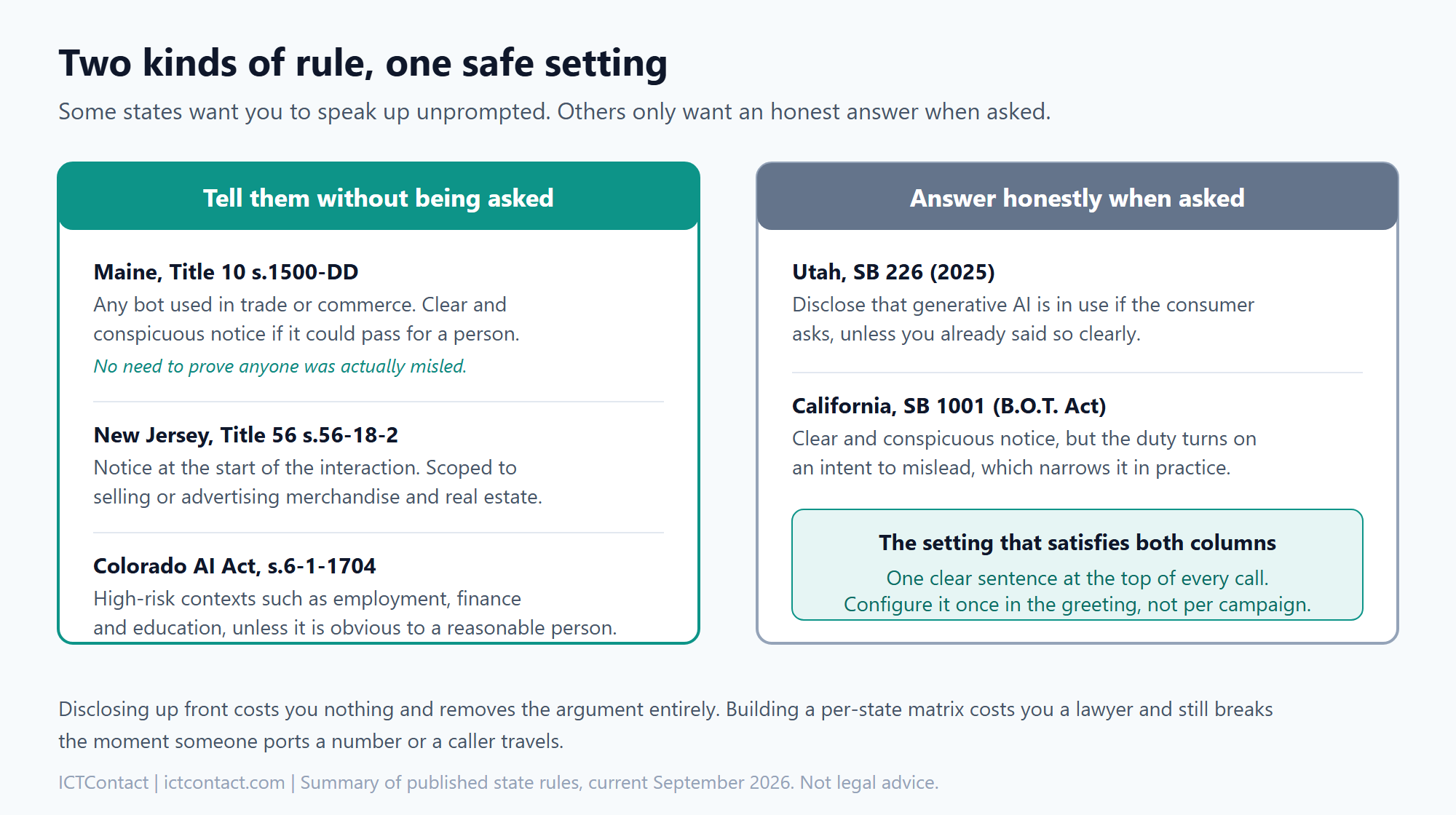
Maine is the broadest. Title 10, section 1500-DD covers any person using a bot in trade or commerce, and asks for clear and conspicuous notice where the bot could reasonably be mistaken for a human. The detail that should get your attention: a plaintiff doesn’t have to prove consumers were actually misled. The absence of disclosure is the issue, not the damage.
New Jersey is narrower but stricter about timing. Title 56, section 56-18-2 wants clear and conspicuous notification at the start of the interaction, though it’s scoped to selling or advertising merchandise and real estate. If you run property or retail campaigns, assume it applies.
Colorado comes at it from a different angle. The Colorado AI Act at section 6-1-1704 attaches disclosure to high-risk consumer interactions, the kind involving employment, finance or education, and lets you off when it would be obvious to a reasonable person that they’re dealing with software. That obviousness carve-out is doing a lot of work, and I wouldn’t lean on it. Voice synthesis got good enough that “obvious” is no longer a safe bet.
The states that only want an honest answer
Two well-known laws turn out to be gentler than their reputation.
Utah’s SB 226, passed in 2025, asks you to disclose that generative AI is in use if the consumer asks, unless you already said so clearly. That’s a reactive duty. Your agent needs to answer “am I talking to a robot?” truthfully, which is a prompt design question more than a compliance project.
California’s SB 1001, the one everyone calls the B.O.T. Act, reads tougher than it bites. It asks for clear and conspicuous notice, but the duty hinges on an intent to mislead for certain purposes. In practice that narrows it considerably. Plenty of teams assume California is the strict one and Maine is the quiet one. It’s the other way round.
Where the disclosure actually has to happen
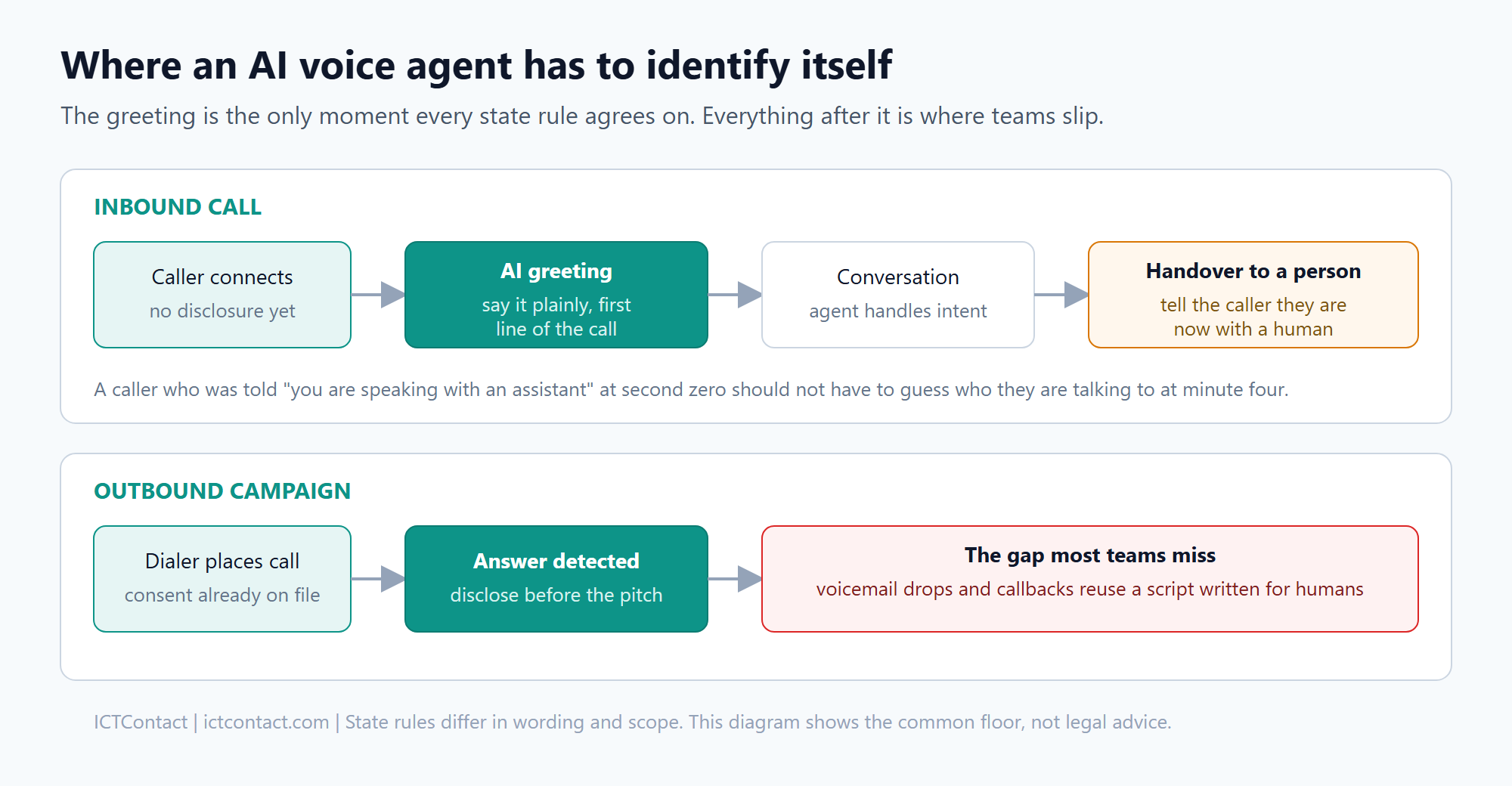
Most teams get the greeting right and then lose the thread. Three moments cause nearly all the trouble.
The handover. A caller told at second zero that they’re speaking with an assistant shouldn’t have to guess who they’re talking to at minute four. When the AI passes the call to a person, say so. It costs a sentence and it prevents the most uncomfortable version of this conversation, which is a customer realising halfway through that they’ve been confiding in software.
Voicemail and callbacks. This is the quiet one. Your live script gets reviewed and updated. The voicemail drop recorded eight months ago doesn’t, and neither does the callback flow that reuses a template written when humans made every call. Go and listen to yours.
Outbound answer detection. Disclose before the pitch, not after. If the first useful thing your agent says is a product name, the notice arrived late.
What a compliant greeting sounds like
Keep it plain. “Hi, I’m an automated assistant from Acme. I can help with billing and orders, or put you through to someone.” That’s it. It names the company, says what it is in words a caller will understand, and offers the exit.
Avoid the clever versions. “I’m Aria, your virtual concierge” is not a disclosure, it’s a brand name with a costume on. If a caller could hear your greeting and still reasonably believe a person is on the line, you haven’t disclosed anything.
One more thing worth saying out loud: disclosure doesn’t hurt completion rates the way people fear. Callers mostly want their problem solved. What annoys them is discovering the deception later, which is exactly the outcome the statutes were written to prevent.
How this sits in ICTContact
The AI voice agent in ICTContact runs on AI Personas, so the disclosure line lives in the persona’s opening script rather than being bolted onto each campaign. Set it once and every campaign that uses that persona inherits it. That’s the behaviour you want, because the failure mode in every other design is a new campaign launched from a copied template that quietly dropped the notice.
The same applies to the handover. Transfers to a live agent are a routing step you configure, which means the “you’re now with a person” line belongs in the routing rule, not in an agent’s memory.
If you’re still mapping out which parts of your stack would even need changing, the feature overview is the quickest way to see where personas, routing and campaign scripts sit relative to each other. Teams running press-1 style outbound should look hard at their broadcast campaign scripts too, since those were often written long before any AI was involved and tend to be the last thing anyone audits.
Where this is heading
The direction of travel is clear even if the details aren’t settled. A separate wave of laws aimed at companion chatbots has been landing since late 2025, and those go much further than disclosure: crisis detection, referral duties, protections for minors. New York’s rules took effect in November 2025, California’s SB 243 in January 2026, and Oregon, Washington, Nebraska and Idaho have all queued up obligations for 2027.
Contact centers aren’t companion apps, and most of that won’t apply to you. But legislatures borrow language from each other, and the phrase that keeps surviving every draft is the simple one about telling people they’re not talking to a human. Build for that and you’ll be fine.
One caveat, stated plainly: this is a summary of published rules as they stand in September 2026, not legal advice. Scope and wording differ between states, several of these laws are new enough that nobody has tested them in court, and your counsel should see anything you’re about to ship.
Frequently asked questions
Does an AI voice agent have to say it’s AI on every single call?
Under the proactive rules, yes, where the agent could be mistaken for a person. Maine’s law doesn’t require anyone to show they were actually misled, so silence is the risk rather than confusion. Disclosing on every call is simpler than deciding call by call.
Is a disclosure in the terms and conditions enough?
No. The laws that specify timing want the notice in the interaction itself, and New Jersey’s says at the start of it. Nobody reads terms before answering the phone, and the statutes were drafted by people who know that.
What about calls to customers outside the United States?
Different regimes apply, and some are stricter. The EU AI Act carries its own transparency obligations for systems that interact with people. If you run international campaigns, treat the US patchwork as your floor rather than your ceiling.
Do we need to disclose when a human agent uses AI assistance in the background?
Generally no, because the caller is speaking with a person. The line matters when AI is the one holding the conversation. That said, if your setup has AI speaking directly to the caller at any point, that part needs the notice.
Does disclosure hurt answer or completion rates?
Less than teams expect. Callers who get their issue resolved don’t generally mind how. The damage comes from a customer working out mid-call that they were misled, which costs more than any measurable dip at the greeting.
Related resources
- ICTContact features
- ICTContact as a complete contact center platform
- Open source Asterisk based contact center software for enterprises
- ICTContact compared with ICTBroadcast
- Product videos
Get your disclosure set up once
If your AI agent is already live, the fastest useful thing you can do this week is listen to one recording from every campaign type you run, including the voicemail drops. You’ll find the gap in about twenty minutes. When you’re ready to fix it in one place rather than campaign by campaign, the ICTContact feature set shows how personas and routing rules carry the notice for you.