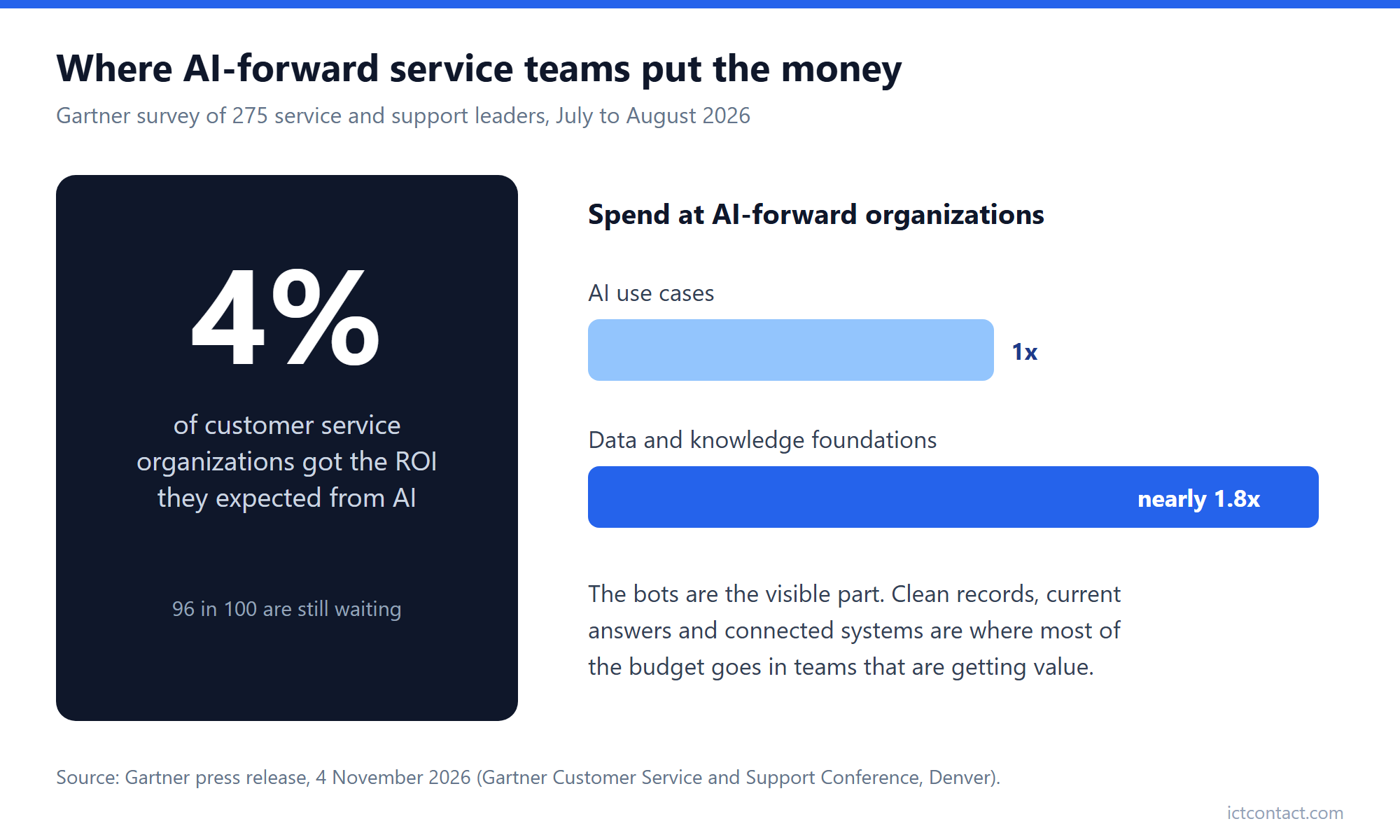
Only 4% of customer service organizations have got the return they expected from AI, according to a Gartner survey released on 4 November 2026. The gap usually isn’t the model. It’s what sits around it: clean records, current answers, and AI that’s wired into the rest of your contact center software instead of running as a side project.
Gartner surveyed 275 service and support leaders between July and August 2026 and announced the result at the opening keynote of its Customer Service and Support Conference in Denver. If you’re in the middle of an AI pilot, or about to sign for one, the release is worth a careful read. It says less about which AI to buy and more about what to fix before you buy anything.
What Gartner actually found
The headline is blunt: just 4% of customer service organizations have achieved the ROI they expected from AI initiatives. Christopher Sladdin, Senior Director Analyst in Gartner’s Customer Service and Support practice, put it this way: “While customer service leaders are eager to accelerate their use of AI, many are failing to unlock its value.”
The release then describes what the more successful, “AI-forward” teams do differently. Three points stand out for anyone running a contact center:
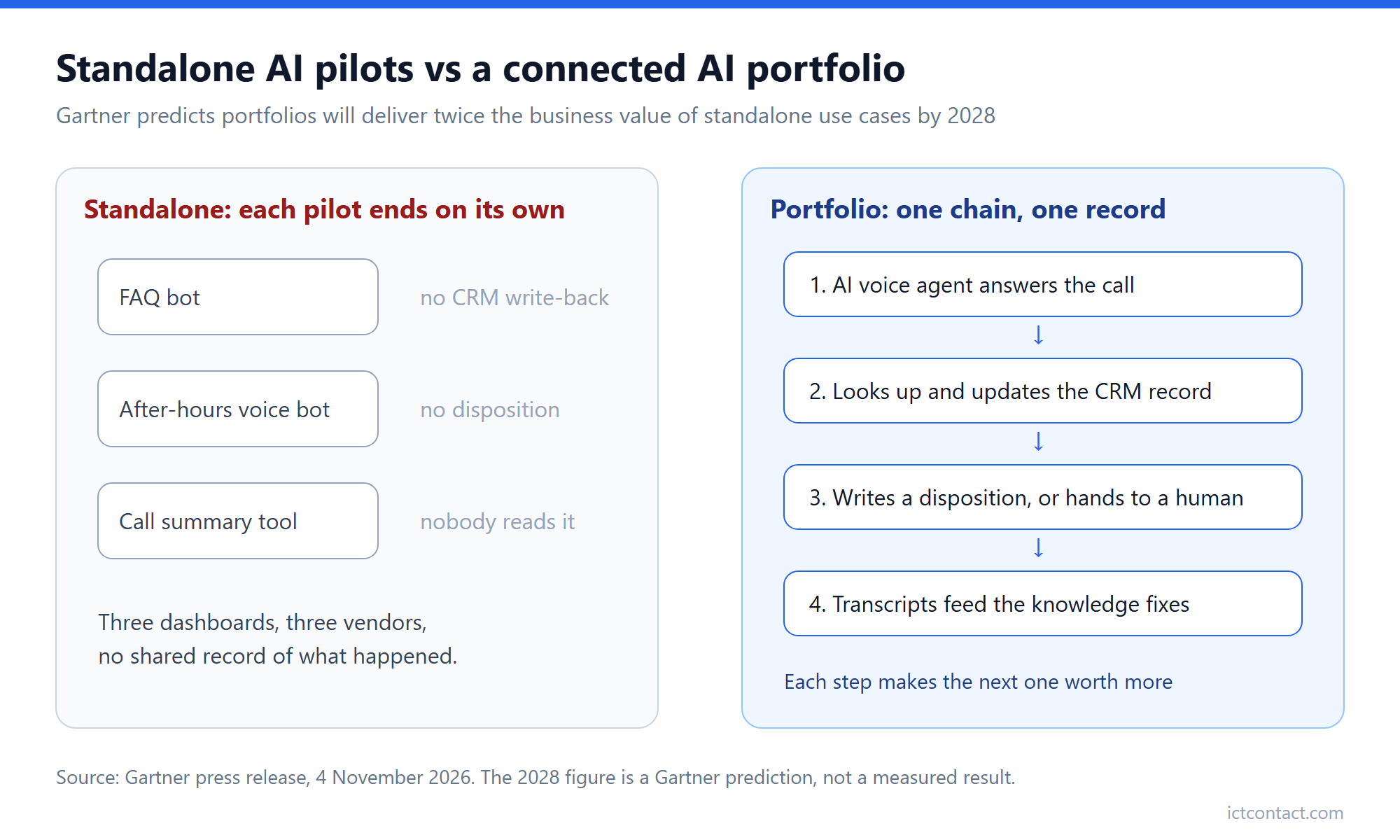
- They build connected portfolios, not one-off pilots. Gartner predicts that by 2028, organizations that build AI portfolios will achieve twice the business value of those pursuing standalone AI use cases. That’s a forecast, not a measured result, but the reasoning is easy to follow.
- They spend more on foundations than on the AI itself. According to Sladdin, AI-forward organizations “invest nearly 1.8 times more in these foundations than in the AI use cases themselves.” The foundations he means are data and knowledge management.
- They use AI to learn, not just to deflect. “AI’s superpower is that it enables leadership to learn from customer interactions at scale,” Sladdin said. The point is to find recurring friction and fix it, not only to cut cost per contact.
On staffing, the release is just as direct: “Humans and AI are not fit for the same job. Each can deliver value, but in different ways. Leaders must stop asking how they remove humans from interactions and instead ask where their involvement creates disproportionate value for customers.”
Why standalone pilots stall
Picture a typical rollout. Someone buys an FAQ bot for the website. Another team adds an after-hours voice bot. A third tool writes call summaries. Each one demos well. Six months later, nobody can say what any of them changed, because none of them write anything back to the place where the customer’s history lives.
The voice bot takes a message but doesn’t set a disposition, so the morning shift calls the customer cold. The summary tool produces paragraphs that no supervisor reads. The FAQ bot answers from a knowledge base last updated in spring. You’ve got three dashboards, three invoices and no shared record of what happened.
That’s what Gartner means by standalone use cases. The alternative is a chain where each step feeds the next: the AI answers, checks the customer record, updates it, sets an outcome or hands off to a person, and the transcripts show you which answers need fixing.
Six checks before your next AI use case
None of these need a new vendor. They’re questions to answer with the tools you already run.
- Write down the ROI you expected. If nobody recorded the target before the pilot, nobody can say it missed. Pick two or three numbers you already track, such as cost per contact, average handle time or the share of calls resolved without a transfer, and note today’s value.
- Check where the AI writes its results. Does a call handled by AI update the same customer record, call log and reports as a call handled by an agent? If the answer lives in a separate vendor portal, it won’t change how your team works.
- Audit the knowledge before adding use cases. An AI agent can only be as current as what you give it. Pull your ten most common call reasons and check that the approved answer for each one is correct today. This is the unglamorous foundation work Gartner says the leaders spend most on.
- Pick one connected chain, not five pilots. One call type, handled end to end, with a clear handoff, teaches you more than five half-finished experiments.
- Design the handoff to a person on purpose. Decide which moments need a human, such as complaints, cancellations or anything with legal weight, and make the transfer carry context so the caller doesn’t repeat themselves. We covered this in more detail in why the handoff is where contact centers win or lose.
- Read the transcripts every week. Pick a sample of AI-handled calls and look for repeated questions, wrong answers and calls that ended in a transfer. That’s the “learn from interactions at scale” part, and it’s where the next fix usually comes from.
How this maps to ICTContact
We built the AI Voice Agent in ICTContact’s Service Provider Edition around the connected model rather than as a separate bot. Here’s what that means in practice, and where your own work still matters.
- It runs inside your call flows. The AI Voice Agent is a node in the visual IVR Designer and works in inbound, outbound and permanent campaigns, so it’s part of the same routing your agents use.
- It works on the customer record. Each AI persona gets a toolbelt you choose, including CRM lookup and update, scheduling a callback, sending an SMS, marking a number as do-not-call, writing a disposition and transferring the call.
- Humans pick up through a normal queue. A transfer goes to a live agent through a standard Asterisk queue, so supervisors see it like any other call.
- One set of reports. AI-handled calls land in the same call records, dashboard and reports as agent calls, and every AI call is transcribed, which gives you the material for check six.
You can see how personas, prompts and tools are set up in the AI Voice Agent guide, or read the overview in how configurable AI personas answer, act and hand off. What the software can’t do is write your knowledge base or decide your targets. That part is still yours, and on Gartner’s numbers it’s where most of the value is.
If you’re planning AI for next year, try a simple test first: take one call type you handle every day and map every system it touches from the first ring to the final note. If the AI can’t reach those systems, fix that before you choose a model.
Frequently asked questions
What did the Gartner survey find about AI ROI in customer service?
Gartner surveyed 275 service and support leaders in July and August 2026 and found that just 4% of customer service organizations have achieved the ROI they expected from AI initiatives. It announced the result on 4 November 2026.
What is an AI portfolio in a contact center?
It’s a set of connected AI use cases that share data and support one business goal, rather than separate tools bought one at a time. Gartner predicts portfolios will deliver twice the business value of standalone use cases by 2028.
Why do AI-forward teams spend more on data and knowledge?
Because AI answers are only as good as the records and knowledge behind them. Gartner says AI-forward organizations invest nearly 1.8 times more in these foundations than in the AI use cases themselves.
Does this mean contact centers should replace agents with AI?
Gartner says the opposite. Its analyst said humans and AI aren’t fit for the same job, and that leaders should ask where human involvement creates the most value for customers rather than how to remove people from interactions.
Which ICTContact edition includes the AI Voice Agent?
The AI Voice Agent is built into the ICTContact Service Provider Edition. It runs inside the IVR Designer, works on the CRM record and transfers to live agents through a standard queue.